2.a. Students identify and analyze diverse information needs of individuals and communities.
Booktalk (LIS 5566- Multicultural Literature for Children and Young Adults) – In a short format video, I presented the book Marcus Vega Doesn’t Speak Spanish to potential readers, and added a short list of similar reads at the end of the video in case the viewer has already read it and enjoyed the book. To prepare for this video and the list of recommendations, after reading the book, I used the Novelist Plus database to help identify read-alikes and then analyzed these suggestions by using my Diversity Toolkit to make appropriate and useful suggestions in my video. You can see the BookTalk video here.
Kinship Determination Project (LIS 5937- Genealogical Research)– In one of my elective courses, I learned about genealogy and how to start research as well as how to deal with obstacles in the search. I took this course because while I did not have a specific interest in the subject, I recognize that many library patrons are heavily interested it. As I worked on this project, I could see how addicting this research can be- uncovering stories and scandals, as well as verifying the most basic of facts- none of it was as easy as doing a simple Google search. I chose to do this project on the people who I am not genetically related to, but who I have known as family my whole life. My father was adopted, so there is no family tree link from them to me, even though I have several artifacts (letters, dog tags, a mink stole) from the most recent couple appearing in my paper. I never got to meet my grandmother, as she died before I was born, so this was an even more meaningful assignment as I learned more about her and who she was, and where she came from. This project demonstrates the variety of ways in which people can access genealogy information as well as a few of the common obstacles patrons often face while doing this type of research. Having firsthand experience with these challenges gives me a clear perspective on how information needs can differ even when looking for similar information. You can see the final paper below.
Diversity Toolkit (LIS 5566- Multicultural Literature for Children and Young Adults)– One of my elective classes centered around multicultural materials for children and young adults. Through the course, we were honing skills for understanding where and when representation is more performative than authentic. This included everything from acknowledging stereotypes and the 5 Fs of culture (food, festivals, fashion, flags, famous people) to learning where to go for reliable sources on what is authentic for a given group of people. This final product is a valuable reference tool for me to use in my career. It demonstrates my personal deep dives into five specific underrepresented groups of people, including a book review, a list of respected authors, a list of group-specific awards, a list of resource links, and a ‘top 5 must-have books’ list for libraries that I compiled for each group, after careful analysis of what was available at the time and how well they would meet the representation needs of each community. You can see it below:
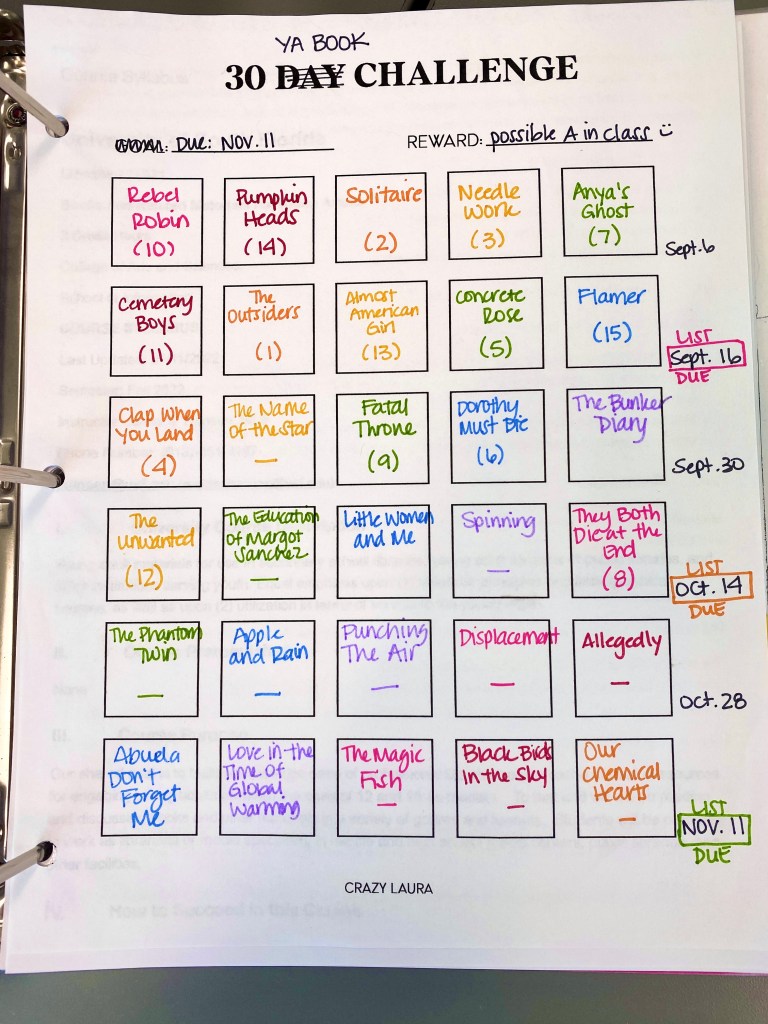
30 YA Books Summary (LIS 6565- Books and Related Material for Young Adults) – In one of my elective courses, I read 30 YA books that covered many categories- graphic novels, fiction, supernatural, nonfiction, contemporary realism, etc. This averaged out to 2.5 books per week, and it was a challenge. But the experience of not only reading that many books but also reading ones that I might not otherwise select really helped me to understand more about the YA group of literature and the wide variety of ways that subjects are covered/addressed. In the summaries written for each of the 30 books, I not only commented on the pros and cons of each title, but also made a determination about what age group I would recommend the book for as well as whether or not I would deem it an essential title for a YA collection in a library, showing that I could identify and analyze the diverse information needs of our YA patrons. Below, I have included my tracking sheet for the 30 books as well as a file showing my report on the first 10 books read.
2.b. Students evaluate and select print and digital information resources and systems to meet needs of users.
LibGuide: Stonewall Riots (LIS 6603 – Basic Information Sources and Services)– I created a LibGuide with resources about the Stonewall Riots. I chose to work on this independently and found a wealth of resources in a wide variety of formats. Knowing that people of all ages might want to know more about this topic, I assembled over 40 resources and organized them so as not to be an overwhelming list, but instead a rich collection. I am particularly proud of the archived footage I found of an interview with one of the police officers who was there, as well as the many videos- from podcasts to documentaries, that address the discrepancies that some historians note between accounts. During this assignment, I paid special attention to the news as it was reported at the time versus how the Stonewall events are viewed historically. This LibGuide demonstrates my evaluation and selection of materials based on relevance and accuracy of information, as there were many resources I evaluated that were not included in the final version. You can see my LibGuide here.
2.c. Students understand and use appropriate information technology for information services.
Kinship Determination Project (LIS 5937- Genealogical Research)– In one of my elective courses, I learned about genealogy and how to start research as well as how to deal with obstacles in the search. I took this course because while I did not have a specific interest in the subject, I recognize that many library patrons are heavily interested it. As I worked on this project, I could see how addicting this research can be- uncovering stories and scandals, as well as verifying the most basic of facts- none of it was as easy as doing a simple Google search. I chose to do this project on the people who I am not genetically related to, but who I have known as family my whole life. My father was adopted, so there is no family tree link from them to me, even though I have several artifacts (letters, dog tags, a mink stole) from the most recent couple appearing in my paper. I never got to meet my grandmother, as she died before I was born, so this was an even more meaningful assignment as I learned more about her and who she was, and where she came from. This paper demonstrates the wide variety of resources that are often needed to conduct proper genealogical research, as well as the need to verify sources and how that was done. You can view this 18 page paper, with numerous photos, images from census date, various registration book entries, and more, below.
 Maggie Finley Portfolio
Leave a comment